
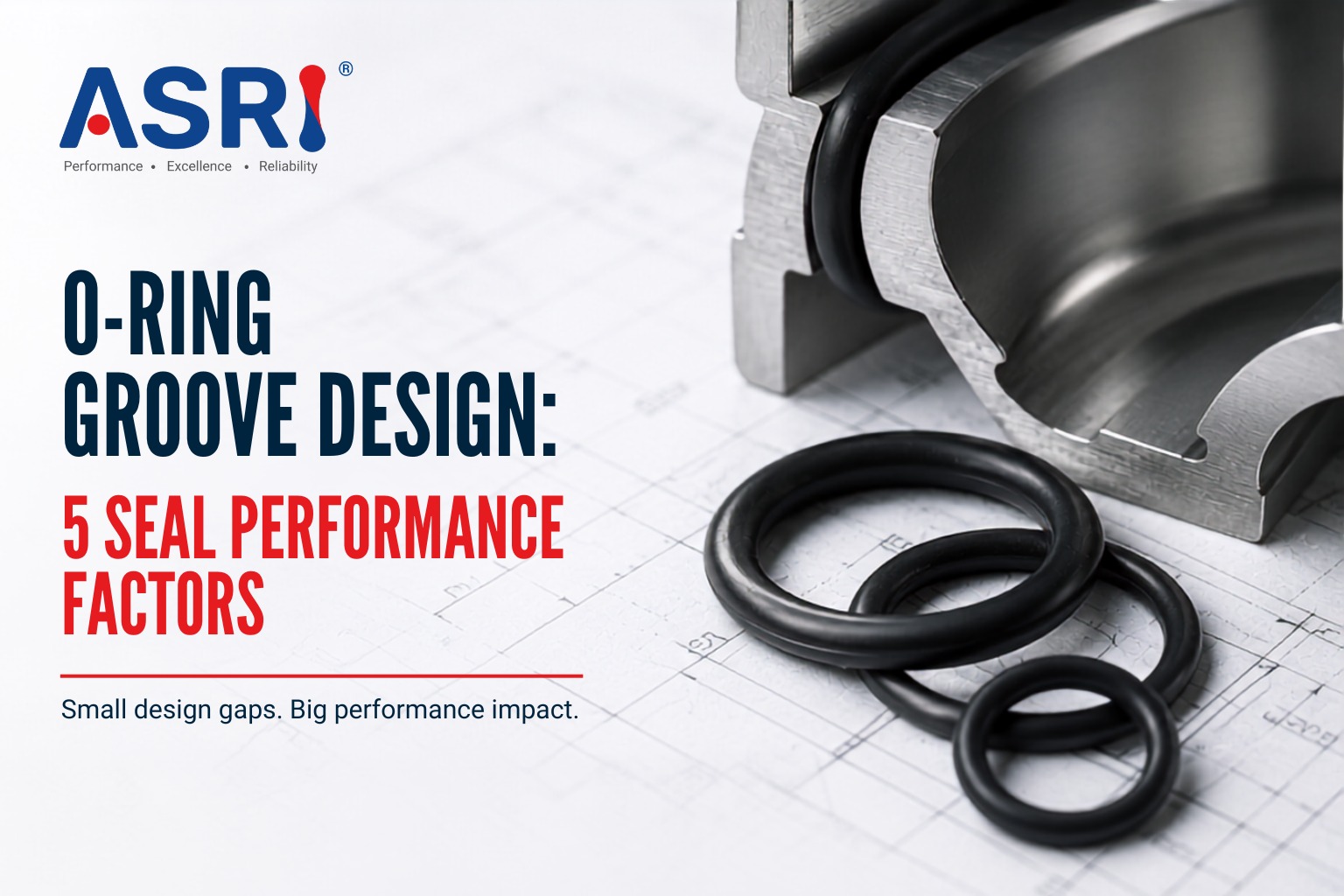
O-Ring Groove Design: Why Small Design Gaps Cause Seal Failure
O-ring groove design determines how a seal is compressed, supported and protected during operation. Incorrect groove dimensions, excessive clearance, unsuitable tolerances or poor surface finish can cause leakage, extrusion, deformation and premature wear.
O-Ring Groove Design: Why Small Design Gaps
Cause Seal Failure
O-ring groove design determines how a seal is compressed, supported and protected during operation. Incorrect groove dimensions, excessive clearance, unsuitable tolerances or poor surface finish can cause leakage, extrusion, deformation and premature wear.
A good O-ring cannot compensate for a poorly designed groove.
What Is an O-Ring Groove?
An O-ring groove, sometimes called a gland, is the space in which an O-ring is installed.
The groove controls how the seal sits, how much it is compressed and how it responds to pressure, movement and temperature changes.
Effective groove design supports:
- Proper compression
- Controlled clearance
- Reduced extrusion
- Improved seal life
- Reliable performance
Exact groove dimensions depend on the seal size, material, application type, pressure, temperature and whether the seal is static or dynamic.
There is no universal groove dimension that works for every application.
Why Does Groove Design Matter?
An O-ring creates a seal by being compressed between two surfaces.
Too little compression may not create enough contact force to prevent leakage.
Too much compression can increase stress, friction, heat and permanent deformation.
The groove must also provide enough space for the rubber to deform without becoming overfilled or trapped.
This balance is what makes groove design a critical part of sealing performance.
Five Groove Design Factors That Affect Seal Performance
1. Proper compression
Compression, also known as squeeze, helps the O-ring maintain contact with the sealing surfaces.
If compression is too low, the seal may not close the leak path effectively.
If compression is too high, the O-ring may experience excessive stress, friction or deformation.
The required compression depends on the material, seal cross-section and operating conditions.
2. Controlled clearance
Clearance is the gap between the mating components near the seal.
Under pressure, rubber can be pushed into this gap. If the clearance is too large, the O-ring may
begin to extrude.
Extrusion can cause:
- Surface damage
- Nibbling
- Material loss
- Leakage
- Complete seal failure
Pressure, rubber hardness and the use of support or backup elements must be considered when establishing clearance.
3. Suitable groove fill
Rubber changes shape when compressed. It may also expand because of temperature or fluid exposure.
The groove must provide enough space for this movement.
An overfilled groove can restrict deformation and increase stress on the O-ring. A groove with too much unused space may not provide sufficient support.
Groove fill should therefore be evaluated under expected operating conditions, not only at room temperature.
4. Controlled dimensional tolerances
Rubber components and machined grooves both have dimensional tolerances.
When these tolerances combine, the actual compression may differ from the intended design.
For example, one assembly may provide adequate squeeze while another assembly using the same drawing may compress the seal too much or too little.
Tolerance analysis helps engineers understand the complete range of possible conditions before production.
5. Appropriate surface finish
The O-ring seals against the surrounding surfaces.
Scratches, machining marks, sharp edges, pits or rough surfaces can create leak paths or damage the rubber during installation and operation.
Surface finish requirements may differ between static and dynamic applications.
Dynamic seals require particular attention because the O-ring moves against the mating surface. Excessive roughness can increase friction and wear, while inappropriate surface characteristics may affect lubrication and sealing.
Common Groove Design Issues
Three design parameters often cause problems:
- Groove dimensions
- Dimensional tolerances
- Surface finish
These parameters directly influence seal compression, leakage prevention, assembly fit and service life.
They should be reviewed together rather than treated as separate drawing details.
Why Do Seals Fail?
Improper groove dimensions, incorrect tolerances or inadequate surface finish can result in:
- Leakage
- Seal deformation
- Extrusion
- Premature wear
- Reduced service life
These issues become more critical under high pressure, dynamic movement and temperature fluctuations.
Seal failure may also be linked to incorrect elastomer selection, chemical incompatibility, installation damage or excessive compression set.
A complete failure analysis should therefore examine both the seal and the surrounding assembly.
Static and Dynamic Groove Design
A static seal operates between surfaces that do not move relative to each other during normal operation.
A dynamic seal operates where movement is present, such as on a rotating shaft or reciprocating rod.
Dynamic applications may involve:
- Friction
- Heat generation
- Lubrication requirements
- Repeated wear
- Changing pressure conditions
The same groove design should not automatically be used for both static and dynamic applications.
Groove Design Checklist
Before approving a sealing design, confirm:
- Is the application static or dynamic?
- What pressure will the seal experience?
- What is the operating temperature range?
- Which fluids or chemicals will contact the seal?
- Is the selected elastomer compatible?
- Is the intended compression suitable?
- Has tolerance variation been considered?
- Is clearance controlled?
- Does the groove provide suitable space for deformation?
- Are the sealing surfaces properly finished?
- Can the O-ring be installed without damage?
Complete Sealing Solutions
At ASRI, we design complete sealing solutions, not just rubber components.
This means considering the O-ring, groove, material, mating surfaces, operating environment and manufacturing tolerances as one system.
By reviewing these factors early, engineers can reduce leakage risk, improve seal life and avoid repeated component changes after production begins.
Frequently Asked Questions
How does groove design affect an O-ring?
The groove controls the O-ring’s compression, clearance, support and available space for deformation. These factors directly influence sealing performance.
What happens if an O-ring groove is too deep?
A groove that is too deep may not provide enough compression, which can reduce sealing force and increase leakage risk.
What happens if an O-ring groove is too shallow?
A shallow groove may over-compress the O-ring, increasing stress, friction, deformation and assembly difficulty.
What causes O-ring extrusion?
Extrusion occurs when pressure pushes the rubber into excessive clearance between mating components.
Does surface finish affect seal performance?
Yes. Roughness, scratches, pits and machining marks may damage the O-ring or create possible leakage paths.
Can one groove design be used for every elastomer?
No. Different elastomers have different hardness, recovery, swelling and temperature behaviour. Groove design must consider the selected compound and application.
Developing a New Sealing Application?
ASRI manufactures O-rings, seals and custom-moulded rubber components for industrial and safety-critical applications.
Talk to ASRI about material selection, groove conditions, operating pressure and expected service life.